· 14 min read
Liquid Culture vs Spore Syringe: A Mycologist's Guide
Compare liquid culture and spore syringes across genetics, colonization speed, contamination risk, and research goals.
For the amateur mycologist, deciding between a liquid culture and a spore syringe is a fundamental choice that impacts the entire research process. The core difference is simple: a liquid culture contains living, active mycelium, while a spore syringe holds dormant spores. Understanding this distinction is key to selecting the right tool for your project, whether your goal is microscopy, genetic isolation, or studying colonization behavior.
This guide will clearly explain the critical differences, comparing colonization speed, genetic makeup, contamination risk, and shelf life. By the end, you’ll be able to confidently choose the best inoculant for your specific mycology work.
Spore Syringe vs. Liquid Culture: Which Is Right for You?
While they may look similar, a spore syringe and a liquid culture represent two distinct stages of the fungal life cycle. Your choice directly influences colonization speed, genetic consistency, and your project’s vulnerability to contamination. Let’s break down what sets them apart.
At a Glance: Key Differences
The table below provides a quick rundown of what separates these two inoculants. It’s a snapshot to help you see where each one shines in a lab or research setting.
| Feature | Spore Syringe | Liquid Culture |
|---|---|---|
| Contents | Dormant fungal spores suspended in sterile water. | Live, growing mycelium in a liquid nutrient broth. |
| Genetic Makeup | Heterogeneous—a mix of countless genetic possibilities. | Homogeneous—a single, isolated genetic clone. |
| Primary Use | Microscopy, taxonomy, and genetic experimentation. | Rapid colonization and producing consistent results. |
| Colonization Speed | Slower, because the spores need time to germinate. | Much faster, since the mycelium is already growing. |
| Contamination Risk | Higher. Spores can carry contaminants from the print. | Lower. Healthy mycelium is vigorous and can outcompete threats. |
| Shelf Life | Very long (1-2+ years when refrigerated). | Shorter (3-12 months when refrigerated). |
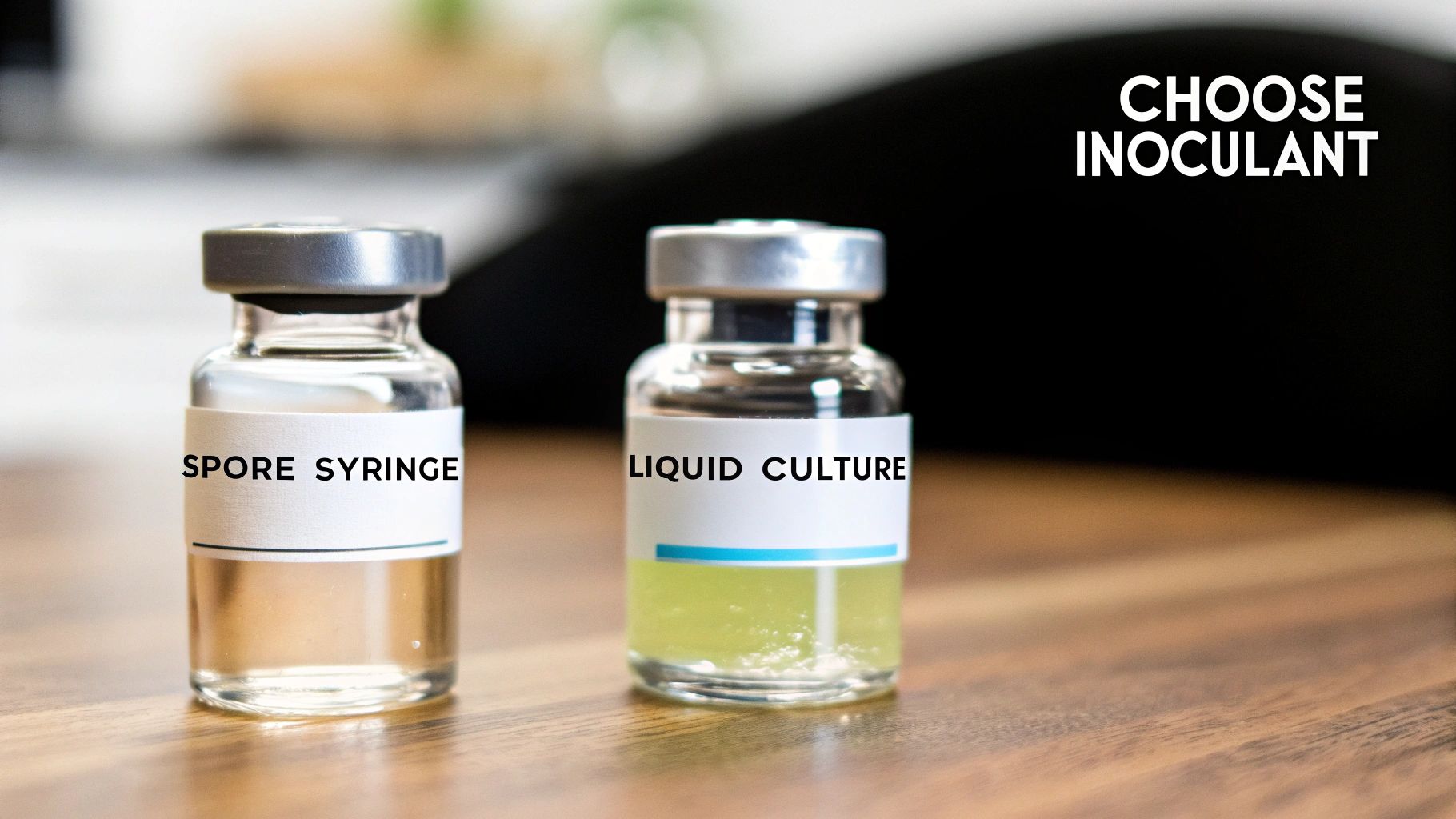
For anyone focused on taxonomy or microscopy, the diverse world within a single drop of spore solution is fascinating. If that’s your goal, our spore syringe collection for microscopy research is the perfect place to start exploring.
Unpacking the Genetics: A Lottery vs. A Sure Thing
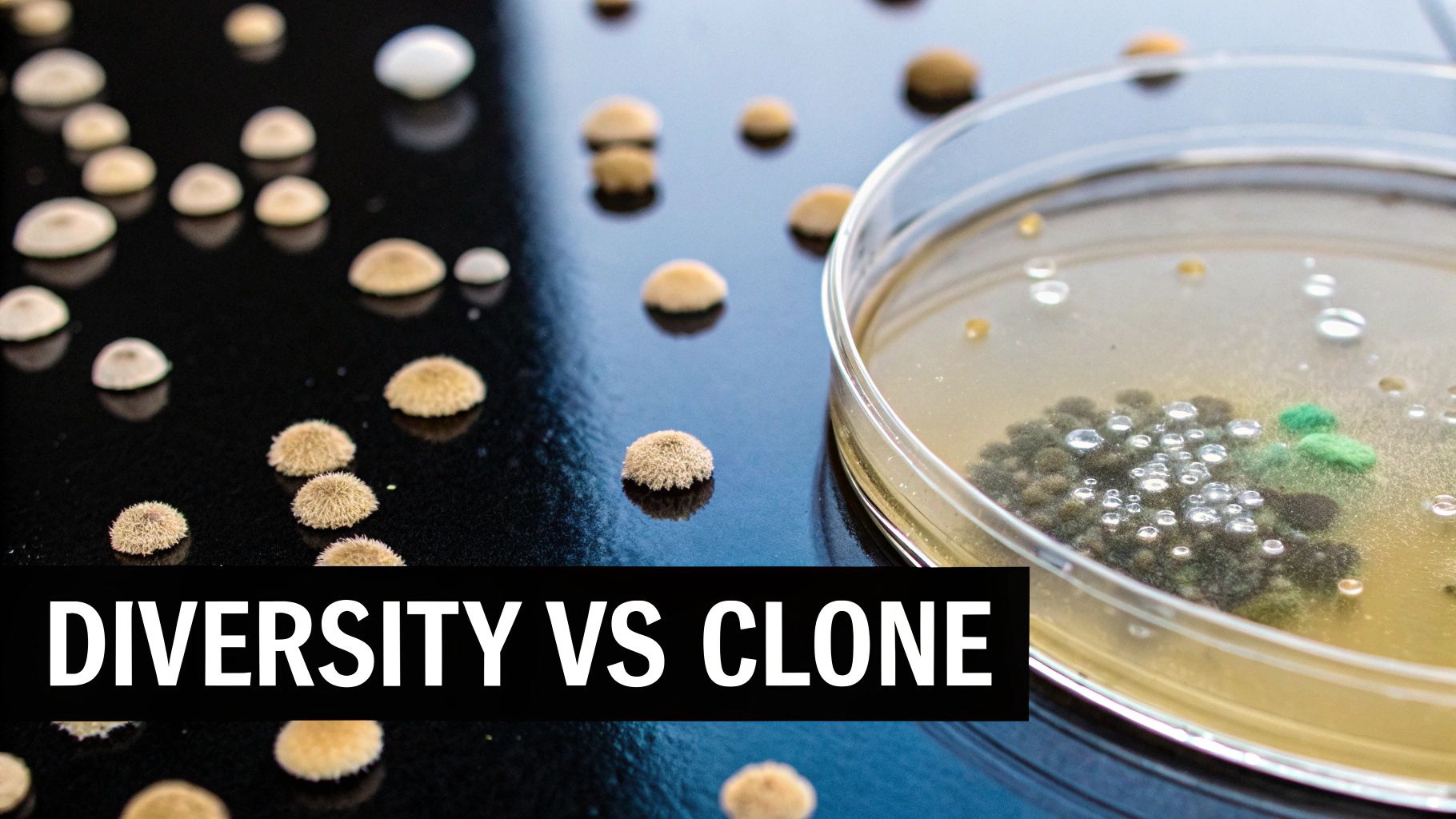
The greatest distinction between a liquid culture and a spore syringe lies in the genetics inside. This single factor changes everything about the predictability, consistency, and potential outcomes of your mycology work. Grasping this concept is key to selecting the appropriate tool for your research.
A spore syringe is like a genetic lottery. It is packed with millions of individual spores, each carrying a unique genetic code. For researchers on a “phenotype hunt”—searching for new traits like unusual shapes or faster growth—this genetic variety is precisely what is needed. However, with that diversity comes unpredictability. A multi-spore syringe will produce a spectrum of results, much like planting seeds from a single apple yields many different, non-identical trees.
The Predictable Power of a Liquid Culture
A liquid culture is the opposite: it is a clone grown from a single, isolated piece of mycelium. Every drop of the solution is genetically identical, which means you get highly predictable and repeatable results.
This consistency is a game-changer for any project that requires uniform outcomes. For a researcher trying to replicate an experiment or a taxonomist studying a specific trait of a species like Psilocybe cubensis, a liquid culture removes the genetic guesswork from the equation.
The Bottom Line: A spore syringe offers a pool of genetic possibilities, perfect for discovery and experimentation. A liquid culture delivers a stable, proven monoculture, essential for work demanding consistency and reliable performance.
What This Genetic Difference Means in the Lab
This choice between diversity and consistency has real-world consequences. When working with spore syringes, researchers must be prepared for variation. Observing these differences is crucial for studying the full range of traits within a species. For a closer look, our guide on how to view spores under a microscope covers essential techniques.
In contrast, a lab using liquid culture can count on uniform colonization speeds, growth patterns, and physical traits from one batch to the next. This reliability is vital for controlled studies where other variables are being tested. Clonal genetics ensure the fungus itself remains a constant.
When to Choose Genetic Diversity
While consistency is often the goal, the variable nature of spores is a feature, not a bug, in certain scenarios.
- Phenotype Hunting: This is the process of isolating new and desirable traits, like resilience or unique growth patterns, from a multi-spore culture. It is foundational to advancing fungal genetics.
- Taxonomic Studies: To truly understand a species, a mycologist needs to observe its full range of expression. Spores provide that complete picture.
- Genetic Archiving: Spores are built for long-term storage, effectively preserving a massive genetic library for future projects.
Ultimately, choosing between a liquid culture and a spore syringe boils down to your objective. Are you venturing into the unknown, hoping to discover something new? Or are you aiming to replicate a specific, known outcome with precision?
All spores are sold for microscopy and taxonomy research purposes only. Cultivation is not permitted where prohibited by law.
Comparing Colonization Speed and Mycelial Vigor
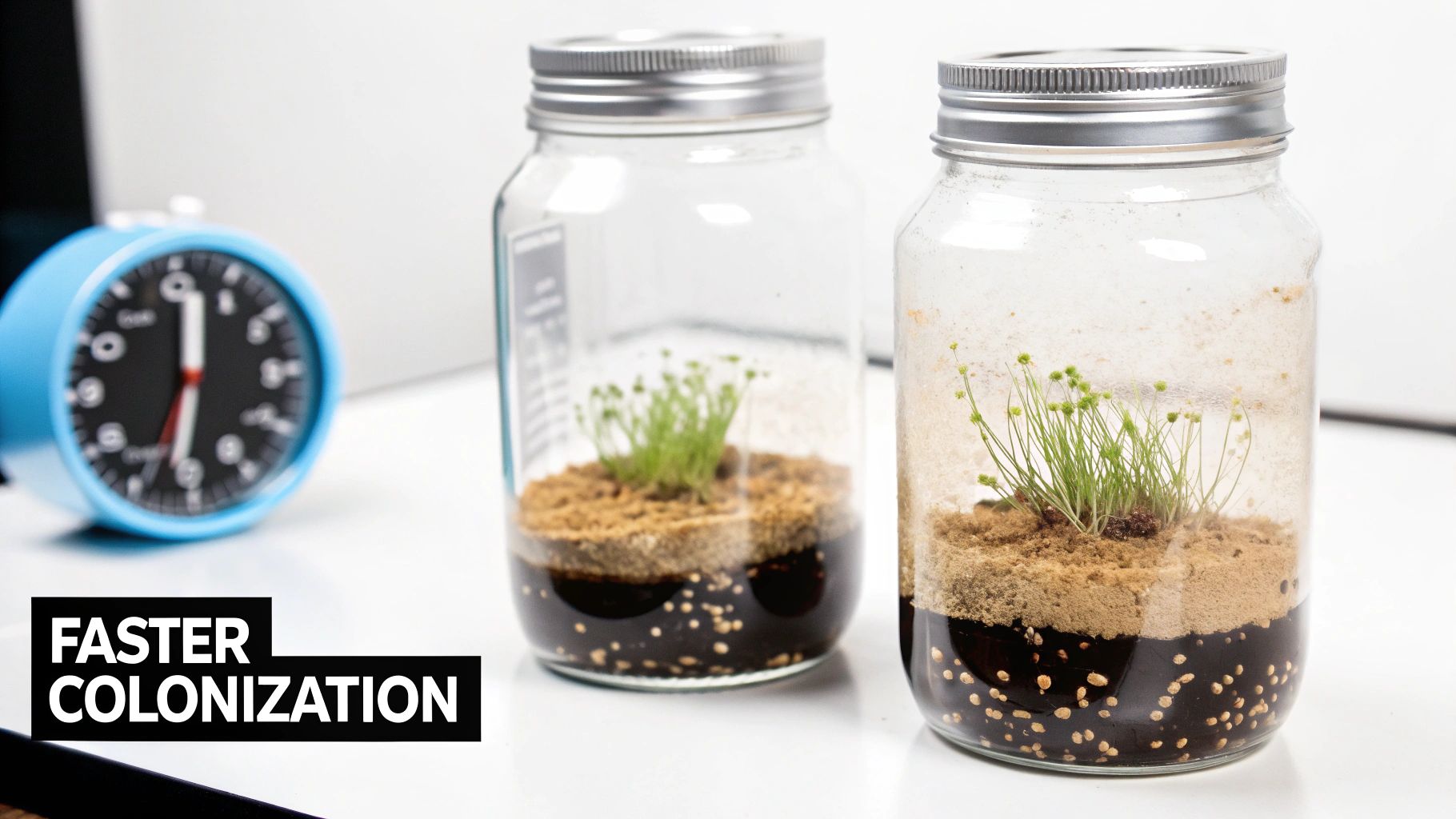
While patience is a virtue in mycology, time is often a critical resource. This is where the practical difference between a liquid culture and a spore syringe becomes most apparent. A liquid culture offers a significant head start.
A spore syringe is the starting line. It contains dormant spores that must germinate, a process that can take several days to a few weeks. Only then can the delicate hyphae begin to form a mycelial network. This initial delay, known as the lag phase, is completely bypassed when using a liquid culture. A liquid culture is an established, living network of active mycelial fragments ready to grow the moment they are introduced to a new substrate.
The Immediate Advantage of Liquid Culture
The key to liquid culture’s speed is its mycelial vigor. A well-prepared liquid culture contains a thriving, robust colony that is already metabolically active. This vigor allows it to aggressively and rapidly colonize a substrate. It is like the difference between planting a seed and transplanting a healthy sapling. The sapling’s root system is already established and ready to draw nutrients to fuel new growth, while the seed must start from zero.
This head start is not just about convenience—it is a strategic advantage. By reducing total colonization times by 30-50%, a liquid culture dramatically shortens the vulnerable window where contamination can take hold.
Quantifying the Speed Difference
This speed boost is well-documented in both research labs and commercial settings. According to a 2021 study cited by the University of Massachusetts Amherst Extension, the use of liquid culture inoculants can significantly reduce colonization times compared to spore-based methods, which is why large-scale cultivators often prefer them. Farms making the switch have seen average colonization times drop from a typical 14–21 days down to just 7–10 days.
Why Speed Matters for Project Success
Faster results offer benefits beyond just saving time. A vigorous mycelial network is a much better defender of its territory.
- Competitive Exclusion: By rapidly consuming available nutrients, the mycelium from a liquid culture effectively starves out bacteria or molds before they can establish a foothold.
- Environmental Resilience: Active, growing mycelium is often more resilient, adapting more quickly to slight shifts in substrate moisture or temperature.
- Reduced Exposure: The less time a substrate spends colonizing, the less time it is exposed to airborne contaminants during its most sensitive phase.
For mycologists working with specific gourmet or medicinal species, this accelerated timeline is invaluable. You can explore our selection of premium gourmet liquid culture syringes to see the difference firsthand.
All spores are sold for microscopy and taxonomy research purposes only. Cultivation is not permitted where prohibited by law.
Analyzing Contamination Risks and Sterility
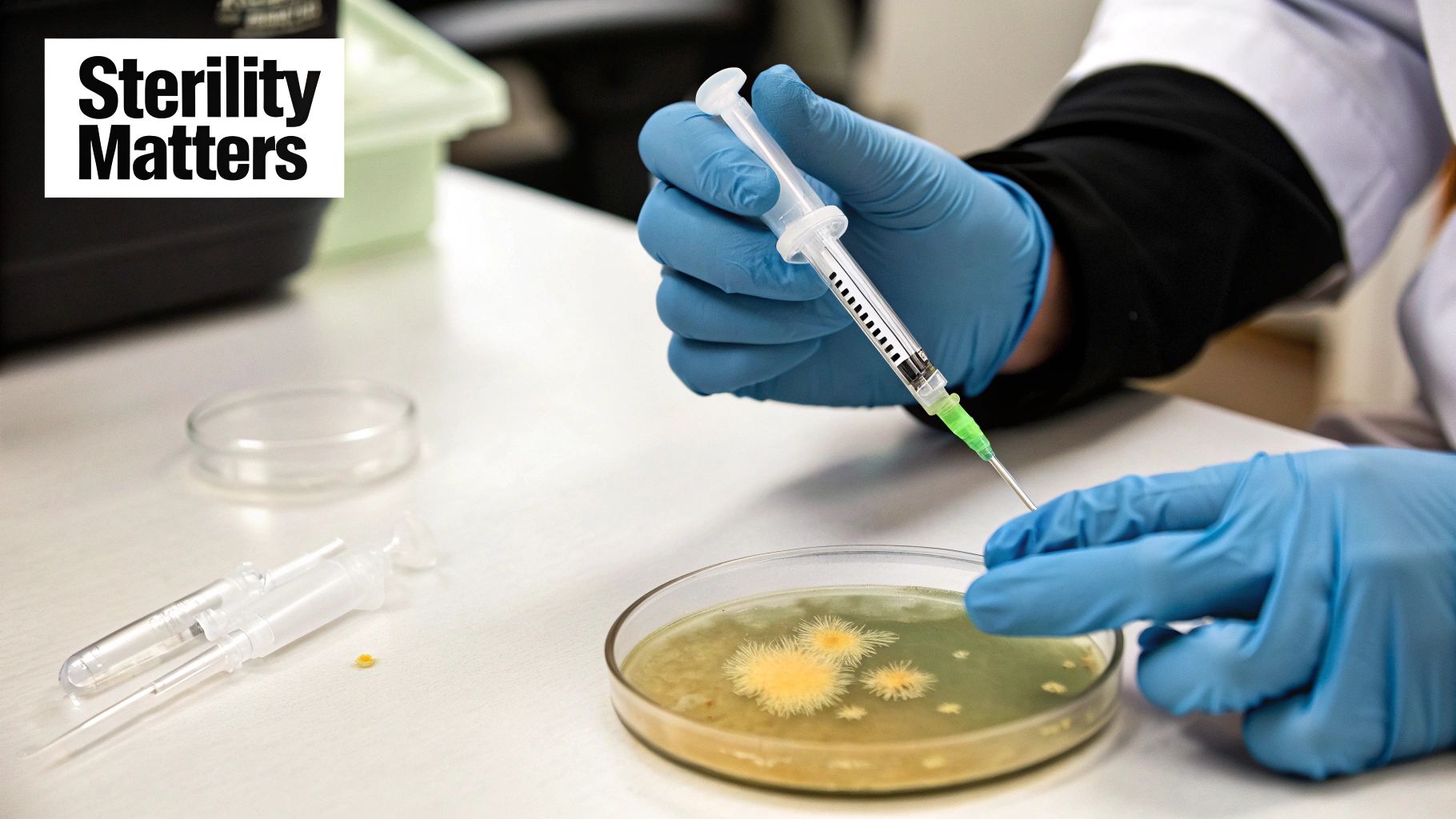
In mycology, managing the constant threat of contamination is a primary challenge. Your choice of inoculant is your first line of defense, and the difference between liquid culture and spore syringes is significant when it comes to sterility.
Spore syringes inherently carry a higher risk of contamination. Spores are collected from mushroom gills, an environment that is not sterile. Despite careful handling, microscopic bacteria or competing mold spores can easily be collected along with the desired fungal spores. This risk is compounded during germination. Dormant spores are defenseless as they begin their life cycle, creating a vulnerable window of several days to a few weeks where faster-growing contaminants can overwhelm the young mycelium.
The Defensive Advantage of Liquid Culture
A professionally prepared liquid culture is a different matter entirely. It contains a vigorous, living mycelial network that is ready to defend its new environment from the moment of introduction. There is no dormant phase; the active mycelium begins colonizing almost immediately. This rapid takeover is its best defense. The mycelium secretes secondary metabolites—natural antibiotic and antifungal compounds—that actively suppress competitors. It claims nutrients so quickly that it effectively starves out threats.
While no method is entirely foolproof, a healthy liquid culture provides a massive biological advantage against contamination right from the start.
Data-Driven Risk Assessment
The difference in contamination rates is a well-documented reality. Data from mycology labs and cultivator surveys consistently show spore syringes having a contamination rate between 10–30%. In sharp contrast, liquid cultures used with proper sterile technique typically see contamination rates of 5% or less. A survey referenced in multiple mycology forums found that beginners using spore syringes reported a 28% contamination rate, while those using liquid culture reported only 6%. You can dig into a deeper breakdown of these mycology inoculant findings to see the full picture.
Quick Comparison of Contamination Factors
| Attribute | Liquid Culture | Spore Syringe |
|---|---|---|
| Starting State | Active, living mycelium | Dormant, individual spores |
| Inherent Sterility | High (if prepared correctly) | Lower (spores collected non-sterilely) |
| Typical Contamination Risk | ~5% or less | 10–30%, can be higher |
| Defensive Ability | Immediate colonization, produces antibiotics | None until germination is complete |
| Vulnerability Window | Minimal | 1-2 weeks during germination |
This table clarifies why experienced mycologists often rely on liquid culture when project success is critical.
Mitigating Risks with Proper Lab Procedures
Regardless of the inoculant, disciplined sterile procedure is non-negotiable. Success depends on creating a controlled environment.
- Working Environment: Always work in a still air box (SAB) or in front of a laminar flow hood to minimize airborne contaminants.
- Surface Sterilization: Wipe down all work surfaces, tools, and containers with a 70% isopropyl alcohol solution.
- Flame Sterilization: Use an alcohol lamp or torch to heat the syringe needle until it glows red before and after every inoculation. Allow it to cool briefly before use.
- Personal Protective Equipment (PPE): Wear nitrile gloves, a face mask, and clean clothes.
For researchers, understanding legal obligations is also crucial. Our page on legality and compliance provides important information.
All spores are sold for microscopy and taxonomy research purposes only. Cultivation is not permitted where prohibited by law.
Choosing the Right Tool for Your Mycology Project
In the liquid culture vs. spore syringe debate, there is no single “best” answer. The right choice depends entirely on your objective. Matching the tool to the task is the most critical decision you will make, guided by your experience level, goals, and available equipment.
For some mycologists, the genetic lottery of a spore syringe is exactly what they need. For others, the predictable, clonal nature of a liquid culture is the only way to achieve the consistent results their work demands.
For the Taxonomist and Academic Researcher
If your work is focused on taxonomy or genetics, the spore syringe is indispensable. Its value lies in the raw, unadulterated genetic information it holds. The fundamental work of identifying and classifying a species often involves studying the morphology, size, and unique features of individual spores under a microscope. A liquid culture, containing only mycelium, is useless for this type of analysis.
Key Insight: For microscopy and taxonomy, you must study the “seeds” (spores), not the “plant” (mycelium). A spore syringe is the only tool that allows for this.
For the Hobbyist Breeder and Phenotype Hunter
If you are a hobbyist looking to discover unique phenotypes, the spore syringe is your ticket to discovery. The genetic variety in a multi-spore syringe is a treasure trove of potential. You might find a substrain that colonizes faster, displays an unusual morphology, or proves highly resistant to contamination. The process typically involves germinating spores on agar and isolating the most promising mycelial sectors. Here, variation is the main feature.
For Projects Demanding Speed and Consistency
Whenever predictability is the goal, liquid culture is the clear winner. Because it is a clone, every inoculation will produce a genetically identical organism that grows uniformly. This is crucial for any controlled experiment where the fungus must be a constant, not a variable. Furthermore, its rapid growth makes it the top choice for efficiency and contamination prevention, cutting project timelines by up to 50%.
A Practical Recommendation for Beginners
What’s best for a beginner? The answer depends on what you want to learn.
- For a Comprehensive Education: Starting with a spore syringe forces you to learn the entire fungal life cycle and master sterile technique. It offers a deeper understanding of the process but comes with a steeper learning curve.
- For a Confidence Boost: If your primary goal is to see a successful project through with fewer setbacks, a liquid culture is far more forgiving. Its speed and vigor can overcome minor errors and provide a rewarding experience.
Many newcomers start with a liquid culture to build confidence, then move on to the more nuanced work of isolating genetics from spores. If you’re ready to explore the foundational tools of mycology, our Spore Syringe Collection is an excellent place to begin your microscopy research.
All spores are sold for microscopy and taxonomy research purposes only. Cultivation is not permitted where prohibited by law.
Storage and Shelf Life: A Tale of Two Timelines
Proper storage is critical in mycology. The viability of your specimens directly impacts your work, and this is another area where liquid cultures and spore syringes differ significantly. Your choice depends on your project’s timeline.
Spore syringes are built for long-term storage. The individual spores are dormant, protected by a remarkably tough outer layer called sporopollenin. This natural armor allows them to endure harsh conditions and remain viable for a very long time. When stored correctly, a spore syringe can last for several years, making it the ideal choice for creating a long-term genetic library or archiving rare specimens.
How to Store Spore Syringes for Maximum Longevity
To get the most out of your spore syringes, follow these simple steps:
- Keep it Cool: A refrigerator is ideal. Maintain a steady temperature between 35-46°F (2-8°C). Never freeze them, as ice crystal formation will destroy the spores.
- Keep it Dark: UV light degrades viability. Store syringes in a dark place, like a sealed bag or box inside the fridge.
- Keep it Upright: Store the syringe with the cap on, needle-side up, to prevent leaks and keep spores from clumping near the plunger.
The Shorter Lifespan of Liquid Culture
Liquid cultures are a different matter. They are alive and active. The syringe contains a living colony of mycelium suspended in a nutrient broth. Because the mycelium is metabolically active, it constantly consumes the sugars in the solution. Once this food source is depleted, the mycelial network weakens and eventually dies. Even under ideal refrigerated conditions, a liquid culture typically has a shelf life of just a few months to a year, with vitality decreasing over time.
The Bottom Line: A liquid culture is a “use it soon” tool. Its power lies in its immediate viability, not its longevity. For long-term preservation, spores are the only option.
You can often spot a declining liquid culture by its appearance. Healthy mycelium is typically a cohesive, ropey mass. If it appears thin, wispy, discolored, or broken into a cloudy solution, its viability is likely compromised. To learn more about our commitment to providing high-quality materials, check out our About Us page.
All spores are sold for microscopy and taxonomy research purposes only. Cultivation is not permitted where prohibited by law.
Frequently Asked Questions (FAQ)
Can you make a liquid culture from a spore syringe?
Yes, you can inject spores into a sterile nutrient broth to create a liquid culture. However, this produces a multispore liquid culture, which contains numerous competing genetic profiles. For a true monoculture with consistent traits, researchers first germinate spores on an agar plate. They then isolate the most vigorous mycelial growth and transfer a small piece of that into the liquid culture broth. This advanced technique is the only way to achieve predictable, repeatable results.
Which is better for a beginner, spore syringe or liquid culture?
It depends on your goals.
- Spore Syringes are excellent for learning the entire fungal life cycle from scratch. This path requires more patience and stricter sterile technique but offers a comprehensive educational experience.
- Liquid Cultures are more forgiving and provide a higher chance of success for a first project. The rapid, vigorous growth can outcompete minor contamination, helping build confidence.
If you want to learn the science from the ground up, start with spores. If you want a quicker win on your first attempt, a liquid culture is a great choice.
Why are spore syringes legal in more places?
The legality comes down to the absence of active compounds. Mushroom spores, like seeds, do not contain psilocybin. This makes them legal for microscopy and taxonomy research in many jurisdictions. Our legality and compliance guide provides more detail. In contrast, liquid cultures contain living mycelium, which can produce controlled substances. This makes possession of liquid cultures illegal in any jurisdiction where cultivation is prohibited. Always check your local laws.
All spores are sold for microscopy and taxonomy research purposes only. Cultivation is not permitted where prohibited by law.
At Mushroom Spores, our commitment is to provide premium, documented specimens for legitimate research. When you’re ready to start your next microscopy project, explore our spore syringe collection for the quality you can trust.